






Follow rail road tracks and a steep but well-maintained mountain trail for this 22-km round-trip hike to Jomon Sugi, the largest tree on the island. Viewing is restricted to an observation deck, but I've never seen another tree like this, and the hike there is something of a right-of-passage. You'll pass other incredible Yakusugi trees and go inside Wilson's Stump along the way.
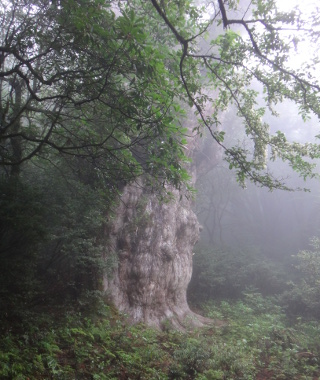 Jomon Sugi, est. age of 2,170~7,200
years.
Jomon Sugi, est. age of 2,170~7,200
years.
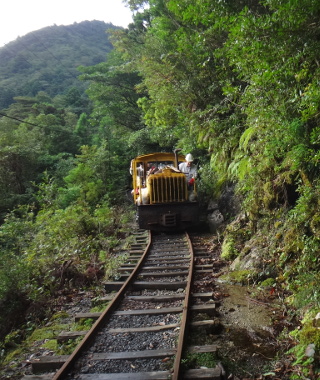 Start by following 8.5 km of old logging
tracks. If you're lucky you may see the train.
Start by following 8.5 km of old logging
tracks. If you're lucky you may see the train.
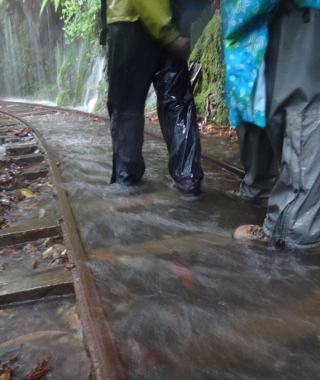 This is one of the rainiest areas in
Yakushima!.
This is one of the rainiest areas in
Yakushima!.
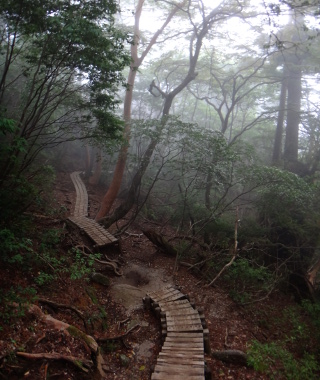 Leave level ground behind for the last
2.5 km.
Leave level ground behind for the last
2.5 km.
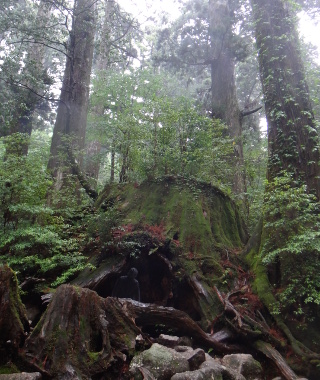 Stop by Wilson's Stump, a tree cut down
around the age of 3,000 years.
Stop by Wilson's Stump, a tree cut down
around the age of 3,000 years.
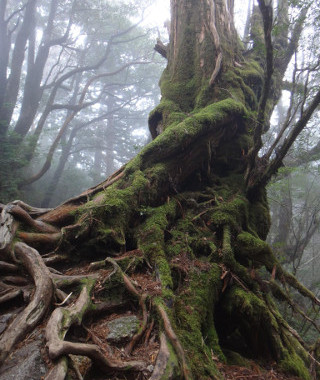 The forest becomes increasingly mystical
as you approach Jomon Sugi.
The forest becomes increasingly mystical
as you approach Jomon Sugi.
Links:
- Certified Guide List
- Town Page
- Hiking Notification
- Brochure and Island Map
- Trail Times, Bus Schedule
- Yakushima Life Page
Content last updated in 2020.
- Experience Level:
- Intermediate
-22 km long - Trail Head Access:
- Bus or Taxi (or Car December~February)
- Time:
- 8~11 Hours
- Round Trip Distance:
- 22 km
- Trail Head Elevation:
- 600 m
- Peak Elevation:
- 1285 m
| Deer/Monkey Sightings | ☆☆☆☆☆ |
| Yakusugi Trees | ☆☆☆☆☆ |
| Mossy Forests | ☆☆☆☆☆ |
| Vista Views | ☆☆☆☆☆ |
| Endurance | ⚠⚠⚠⚠⚠ |
| Strength & Technicality | ⚠⚠⚠⚠⚠ |
| Crowds | ⚠⚠⚠⚠⚠ |
| Weather Cancellations | ⚠⚠⚠⚠⚠ (Extreme rains, rarely snow) |
- Costs:
-
The town of Yakushima recommends a voluntary donation of ¥1000
(valid for all World-Hertiage Site day hikes in one month) per hiker combine with a ¥1400 for roundtrip bus
ticket from the Museum bus stop in Anbo for a total of ¥2,400. Check bus times and costs for early morning and
afternoon connecting buses to the Museum.
For a guided hike expect to pay from ¥10,000 to ¥20,000 depending on season, number of hikers, options, etc.
The cost of a taxi from Anbo runs around ¥5000 (2020) each way. - Getting to the Trailhead (GPS coords: 30.3400, 130.5953):
- You can either take a taxi or the shuttle bus from the Museum bus stop. Because of the popularity of this trail (several
hundred hikers for a typical day in summer), use of the bus is strongly encouraged. Private cars are not allowed access to the
trail head from March through November. Early morning and afternoon buses connect eastern stops from Issō in the north through Onoaida in
the south. If you miss the last return bus or connecting bus, you'll have to call a taxi.
When you arrive on the island, go ahead and buy your shuttle bus tickets so they can prepare enough buses for everybody. If your hike is canceled, you can return recent unused tickets to an information booth for a refund. From most lodgings, you will be able to order a bento-style breakfast and lunch box the afternoon before your hike, to be delivered to the front door of you lodging by 4am the next morning. When you arrive at the Museum bus stop, follow directions to line up for the shuttle bus. It may be too crowded for you to board the next bus, but overflow buses will be arranged so that everyone can get to the trail head at a reasonable time. It's a good idea to eat your breakfast while you wait for the bus, because you are not allowed to eat inside the bus (It's a winding, 35-minute ride, and the smell of food makes some people car sick.) and shelter is limited once you get to the trail head.
- Toilets:
- There toilets at the Museum bus stop, trail head, midpoint and end of the train tracks, and (if you have a half hour to spare) at the hut beyond Jomon Sugi, although use of the hut toilet by day hikers is discouraged. All other waste and toilet paper, including wag bags, must be carried out. There booths along the trail for use with a toilet kit (wag bag) if you bring one.
- Equipment List:
- Water Bottle, Breakfast + Lunch + Snacks, Headlamp + Batteries, First Aid Kit, Rain Jacket + Rain Pants, Hiking Shoes, Spare Jacket, Disposable Toilet Kit, etc.
- The Hike:
- The trail is narrow and highly trafficked, so try to keep all members of your group close, walk single file, and yeild to hikers
going towards Jomon Sugi. The first half of the trail is an 8 km walk on a board-walked train track (still in use to service the toilets) through the
heart of the logging village of KosugiDani, which closed in 1970. Some of the former inhabitants who grew up and went to schoool there
still live in other parts of the island. This should take you less than three hours.
Stop at the toilets at the end of the train tracks before heading up the Ōkabu Trail (literally, Big Stump Trail). There are a lot of narrow stair cases, and almost everywhere else is rocky, so try to be patient with large groups; their leaders should let you pass as soon as they are at a safe space to stop. About a half-hour into the Ōkabu trail, you should arrive at Wilson Stump. Go inside, pay your respects to the tree spirit, and photograph the "heart." There may be a que. Upon departing Wilson's Stump, the trail splits into the affectionately nicknamed "staircases of hell" and the "nature observation trail," which is a longer, less maintained, and a lot less traveled. These trails will join together again after climbing about 100 meters in elevation. From shortly after where these trails intersect until shortly before the observation deck there are occasional spaces to sit and each lunch on the boardwalk without blocking the trail or hurting the trail-side plants. The observation deck is pretty busy from around 11:15 until 12:45, but if you can often avoid much of the crowd simply by choosing to eat your lunch before or after you see Jomon Sugi. You may not eat lunch on the observation deck.
The observation deck itself is quite large, and although it does not wrap all the way around Jomon Sugi, you can get several very different perspectives.
If, for some reason, you can't make it back in time to catch the bus, during tourist season, there is an attendent at the trail head until 8pm, and depending on your carrier, there is mobile phone service at the trail head. If you do not have a mobile phone, you will have to walk 4km up the road to reach a pay phone.
- In the case of bad weather
- The same way you came is also the surest route out of the moutains. The trail does not usually flood, but if it become dangerous to hike,
or if the road to the trail head becomes impassible, there are rare occasions when hikers have to wait until the next day and walk down. If this
is likely, buses to the trail head will cease operations, but since the weather is highly unpredictable, you should always bring full rain gear
just in case you have to spend the night. There are water and emergency rations at the trail head (2020). Depending on your carrier, there is
cell phone service at the trail head, between DaiŌ Sugi and the entrance to the World Natural Heritage Site, and on the Jōmon Sugi observation deck.
About a ten minute hike beyond Jomon Sugi is Takatsuka Hut, which is an emergency shelter. The trail leading from the railroad tracks to Shiratani Unsuikyo Park and the service trail in the vicinity of Takatsuka Hut are much more difficult and are also prone to flooding and should not be considered in most cases. Because of the high volume of hikers, rescue missions (by train, foot, or helicopter) in this area are not uncommon, but may be delayed by inclimate weather.